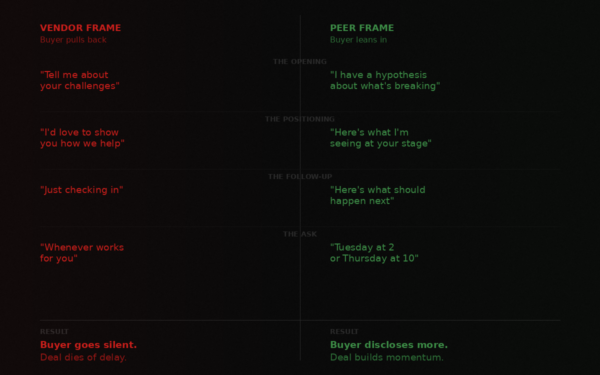
There’s a force running underneath every sales organization in B2B. It governs pipeline velocity, forecast accuracy, win rates, and the length of your average sales cycle. Most revenue leaders have never named it. They feel its effects every quarter – in deals that stall, in forecasts that miss, in buyers who disappear after a promising second call – but they treat each symptom as a separate problem.
It’s not. It’s one problem. And the science that explains it has been published for decades. Your sales leadership just hasn’t read it.
The Research Your Revenue Leader Has Never Seen
In 1966, psychologist Jack Brehm published a theory called psychological reactance. The core finding: when people perceive that their freedom to choose is being restricted or threatened, they experience a motivational state that drives them to restore that freedom – often by doing the opposite of what’s being asked.
This isn’t a personality trait. It’s a universal human response. The harder you push someone toward a decision, the harder they push back. Not because your product is wrong. Not because your pricing is off. Because the act of pushing triggers a psychological immune response.
Now think about what most B2B sales processes are engineered to do. Every stage gate incentivizes forward motion. Every forecast review puts pressure on the rep to “advance” the deal. Every end-of-quarter push communicates urgency that belongs to the seller, not the buyer. The entire system is designed to maximize pressure on the buyer to move forward.
Brehm’s research tells us exactly what that pressure produces: resistance. Not objections – resistance. The kind that doesn’t show up in your CRM. The kind that looks like a buyer who “went dark” or a deal that’s been sitting in Stage 3 for eleven weeks with no movement and no rejection.
Your team calls that a “stalled deal.” Behavioral science calls it a predictable outcome.
The $3.4 Million Experiment You’re Running Every Year
The average B2B company with a 20-person sales team spends roughly $3.4 million annually on sales compensation alone. Add management, tools, training, and overhead, and you’re north of $5 million.
That investment is running on an operating assumption that hasn’t been examined since before your buyers had access to the internet: that more seller activity produces more closed revenue.
It doesn’t. Not anymore.
Gartner’s research on B2B buying behavior found that buyers now complete between 70% and 80% of their evaluation before engaging a sales rep. Forrester’s data puts the average B2B buying committee at 6 to 14 people. And CSO Insights – before they were absorbed into Korn Ferry – documented a steady, multi-year decline in forecast accuracy across B2B sales organizations, even as CRM adoption and sales tool spending hit all-time highs.
More activity. More tools. Worse outcomes.

If your operating assumption were correct – if more seller activity reliably produced more revenue – those trend lines would move in the same direction. They don’t. They move in opposite directions. And they’ve been diverging for over a decade.
That’s not a training gap. That’s a structural failure in the underlying model.
Five Methodologies. One Shared Blind Spot.
BANT was formalized in the 1960s. Sandler in 1967. SPIN Selling in 1988. MEDDIC in 1996. Challenger in 2011. Gap Selling in 2019.
Every one of these methodologies was designed for a market where the seller controlled information. Where the buyer needed the sales rep to understand the product, compare options, and navigate procurement. Where seller activity was the primary engine of deal progression because the buyer had no other way to move forward.
That market ended somewhere around 2015. The methodologies didn’t update.
Today’s B2B buyer arrives at the first sales conversation having already consumed analyst reports, peer reviews, community discussions, and competitor comparisons. They’ve built a shortlist. They’ve established evaluation criteria. They may have already eliminated you before your rep sends the first email.
In this environment, every technique designed to “control the conversation,” “challenge the buyer,” or “create urgency” is working against the grain of how people actually make decisions. And it’s not because the techniques were wrong when they were written. It’s because they were written for a buyer who no longer exists.
This is the blind spot every legacy methodology shares: they treat the seller as the protagonist of the deal. The one who discovers, who challenges, who drives, who closes. In 2026, the buyer is the protagonist. The buyer was always the protagonist. The seller’s role has fundamentally changed – and no amount of better execution inside the old framework will fix that.
The Number That Explains “No Decision”
In 1979, Daniel Kahneman and Amos Tversky published Prospect Theory, which later earned Kahneman the Nobel Prize in Economics. Among their findings: losses are felt approximately 2 to 2.5 times more intensely than equivalent gains.
This is arguably the most important finding in behavioral economics for anyone running a revenue organization. And almost no one is applying it.
Here’s what most sales processes do: they ask reps to articulate the value of the solution. ROI calculators. Business cases. “If you implement our platform, you’ll gain X in efficiency, Y in revenue, Z in cost savings.”
The problem is that gains are psychologically weak. Kahneman proved this. A projected gain of $500,000 produces roughly half the motivational force of a projected loss of $500,000. Same number. Dramatically different psychological impact.
Now look at your pipeline. How many deals are sitting in Stage 3 or 4, “progressing” based on a business case built around projected gains? Your rep is excited because the buyer acknowledged the ROI model. But the buyer hasn’t felt anything. The math landed in their spreadsheet, not in their gut.
This is why 60% or more of forecasted deals end in “no decision.” Not lost to a competitor. Not killed by procurement. Simply abandoned – because the emotional force required to push a buying committee through internal politics, procurement, and implementation risk was never generated.
A gain-framed business case can’t generate that force. A conversation about what the status quo is costing them every quarter they don’t act? That’s different. That reaches the part of the brain where decisions actually get made.
The question isn’t “What will you gain if you implement?” The question is “What is this problem costing you right now – and what does another year of it look like?” One is a spreadsheet exercise. The other is the conversation that keeps a CFO awake at 2 AM.
Three Questions for Your Next Pipeline Review
If you’ve read this far, you’re probably running the numbers in your head. Here’s how to pressure-test your own pipeline against the science.
On every deal in Stage 3 or later, ask: “What happens to this buyer’s business if they do nothing for another 12 months?” If your rep can’t answer with a specific, quantified number that the buyer validated – not one the rep calculated – the deal isn’t real. It’s forecast decoration.
On your team’s outreach, ask: “Who is talking more – us or the buyer?” Brehm’s reactance research predicts that the party applying more communicative pressure is generating more resistance. If your reps are talking more than 30% of the time in discovery calls, they’re not diagnosing. They’re pitching. And the buyer’s immune response is already activated.
On your sales process, ask: “Are our stage gates defined by what our team did, or by what the buyer agreed to?” Activity-based pipeline stages – “Demo completed,” “Proposal sent,” “Follow-up scheduled” – measure seller effort. Agreement-based stages – “Buyer confirmed the problem is a priority,” “All stakeholders acknowledged the pain of doing nothing,” “Buyer proposed a timeline for decision” – measure buyer commitment. Only one of these predicts whether the deal will close.
The Uncomfortable Implication
Here’s the part nobody wants to hear: if the behavioral science is right – and sixty years of peer-reviewed research says it is – then the response to declining pipeline performance isn’t more activity. It isn’t a new script. It isn’t another methodology built on the same assumptions as the last five.
It’s a fundamentally different relationship between seller effort and buyer behavior. One that most revenue leaders have never examined because the assumption underneath their entire operating model has been invisible to them.
There is a governing dynamic between what sellers do and how buyers respond. It’s not random. It’s not situational. It operates in every deal, on every call, in every pipeline.
The question is whether you’re working with that dynamic – or against it.
Most teams are against it. They just can’t see it from inside the system.
I help B2B companies fix the revenue systems that legacy methodologies broke. If something in this post made you uncomfortable, it was probably the part that's true. Stop the bleeding.