The Voicemail Graveyard
You had a great discovery call. The prospect was engaged, asked smart questions, even mentioned their timeline. You sent a thoughtful follow-up. Then nothing. A week passes. You send another email. Nothing. You call. Voicemail. You try LinkedIn. Read receipt, no reply.
Your manager asks about the deal in the pipeline review. You say they’re probably busy. You both know what that means.
This isn’t a follow-up problem. It’s not a timing problem. And it’s not because your prospect is actually busy. People make time for things that matter to them. Your prospect just told you – without saying a word – that your conversation didn’t matter enough to continue.
The question worth asking isn’t “how do I get them to respond.” It’s “what happened in our interaction that made them want to stop.”
The Energy Equation
There’s a principle that governs every buyer-seller interaction, and most sales organizations have never heard it articulated.
The equation essentially states the harder you push, the more the buyer pulls back. Reduce your force, and they lean in.
Think about the last time a car salesperson followed you around a lot. What did you do? You left. Not because the car was wrong. Because the energy was wrong. The salesperson needed the sale more than you needed the car – and you could feel it.
Now think about the last time someone gave you space after showing you something genuinely interesting. You went back. You asked questions. You pursued.
The same physics govern B2B sales. Every “just checking in” email, every “wanted to circle back” voicemail, every “bumping this to the top of your inbox” message is seller force. And every unit of force you apply reduces the buyer’s natural pursuit by exactly the same amount.

Vendor Energy Vs. Peer Energy
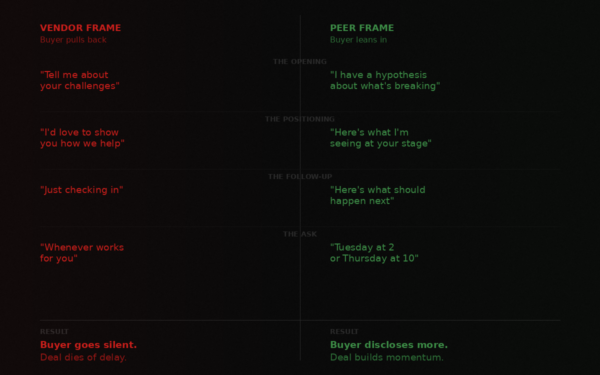
Vendor energy is the default. It sounds like: “I’d love to show you how we can help.” “Whenever works for you.” “Just wanted to follow up on our conversation.” It’s deferential. It positions the seller below the buyer. It signals that the seller needs the deal more than the buyer needs the solution.
Peer energy sounds different. It sounds like: “I’ve been looking at your pipeline metrics and I have a hypothesis about what’s happening. Am I wrong?” It’s direct. It positions the seller as an equal – someone with expertise the buyer doesn’t have, offering a diagnosis the buyer can’t do themselves.
Buyers ghost vendors. They don’t ghost peers. A vendor is someone you avoid because the interaction feels extractive. A peer is someone you make time for because the interaction feels valuable.
The Inversion Principle
Peer positioning isn’t a communication style. It’s a strategic choice about where you stand in the conversation. When you operate as a peer, you’re offering a diagnosis. When you operate as a vendor, you’re asking for permission. One creates pursuit. The other creates avoidance.
The Diagnosis That Changes Everything
When a prospect ghosts you, the instinct is to increase effort. More emails. More calls. More creative subject lines. More value-add touches. This is exactly wrong. You’re applying more seller force to a relationship that’s already resisting.
The counterintuitive move is to pull back – and to be honest about why.
Instead of “just checking in,” try: “I haven’t heard back, which usually means one of three things – the timing isn’t right, this isn’t the right priority, or my last message missed the mark. Any of those are fine. If the situation has changed, I’d rather know than keep following up.”
That message works because it does three things simultaneously. It removes seller force by offering a genuine exit. It demonstrates peer energy by being direct instead of deferential. And it gives the prospect permission to tell you the truth – which is the only thing that actually moves a deal forward or clears a dead one from your pipeline.
Why This Keeps Happening At Scale
Individual ghosting is a symptom. The systemic version is more dangerous.
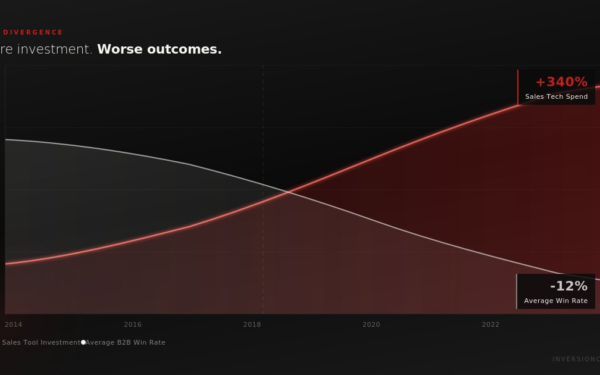
If your team’s win rate is declining while pipeline volume stays flat or grows, you don’t have a pipeline problem. You have an energy problem. Your entire sales motion is generating vendor energy at scale – through templated outreach, scripted discovery calls, and follow-up sequences that treat every prospect like a target instead of a peer.
The reps who consistently outperform? Look at their communication patterns. They ask harder questions earlier. They challenge assumptions instead of validating them. They tell prospects when they’re not a fit. They operate with the confidence of someone who doesn’t need every deal – and paradoxically, that’s exactly why they win more of them.
The Uncomfortable Audit
Pull up the last ten follow-up emails your team sent to prospects who went dark. Read them out loud. Ask yourself: does this sound like a peer reaching out to another executive? Or does it sound like someone hoping to get a meeting?
If the answer is the latter, the ghosting isn’t the problem. The ghosting is the feedback. Your buyers are telling you exactly what’s wrong with your approach. The question is whether you’re willing to hear it.
I help B2B companies fix the revenue systems that legacy methodologies broke. If something in this post made you uncomfortable, it was probably the part that's true. Stop the bleeding.